Look at a water bottle, soft drink bottle, juice bottle, or many other plastic containers around you. Before that bottle gets its final shape, it often starts as a much smaller part called a PET preform.
A PET preform may look simple, but it plays a very important role in bottle manufacturing. Its weight, neck shape, and how the plastic is spread through the part can affect the final bottle. Husky, a maker of PET molding systems, describes the preform as the starting point of bottle production and says it already contains the material needed for the final bottle.
In this guide, we explain what a PET preform is, how it is made, how it becomes a bottle, where it is used, and why PET preform quality is important. We also cover what buyers should look for when choosing reliable PET preform manufacturers.
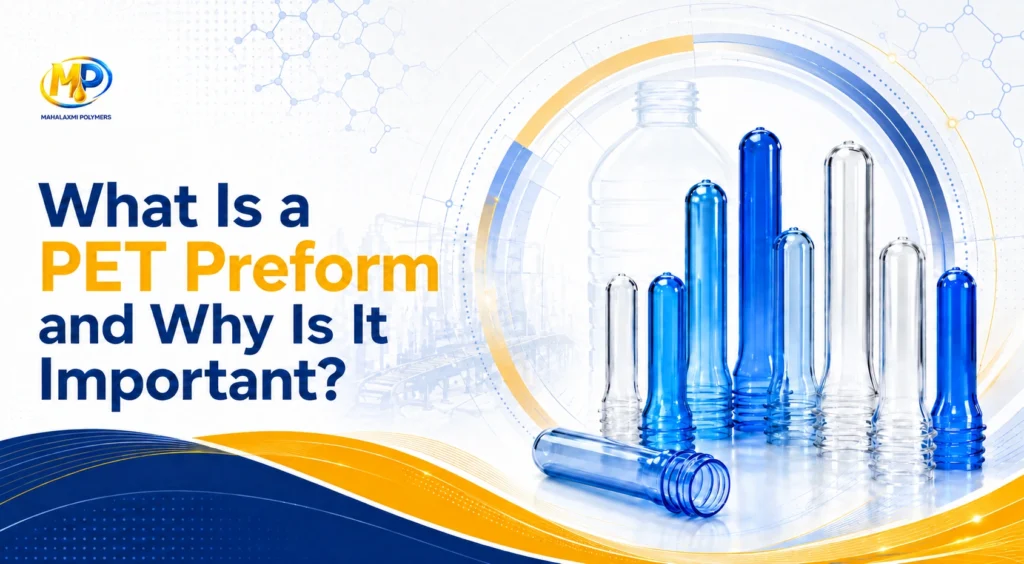
What Is a PET Preform?
A PET preform is a semi-finished plastic piece that eventually becomes molded into a PET bottle or container.
PET is short for polyethylene terephthalate. PETRA states that PET is a clear, strong, lightweight plastic polymer in the polyester family commonly used to make bottles, jars, containers and other packaging.
The preform will already have a finished neck and thread portion. The remainder of the plastic preform is thick and condensed. It will be reheated, stretched and blown into shape during the next step in the production process. Husky adds that preforms are injection molded, and bottles are created by blow molding, reheating and stretching the preform.
In very simple words: PET resin → PET preform → PET bottle
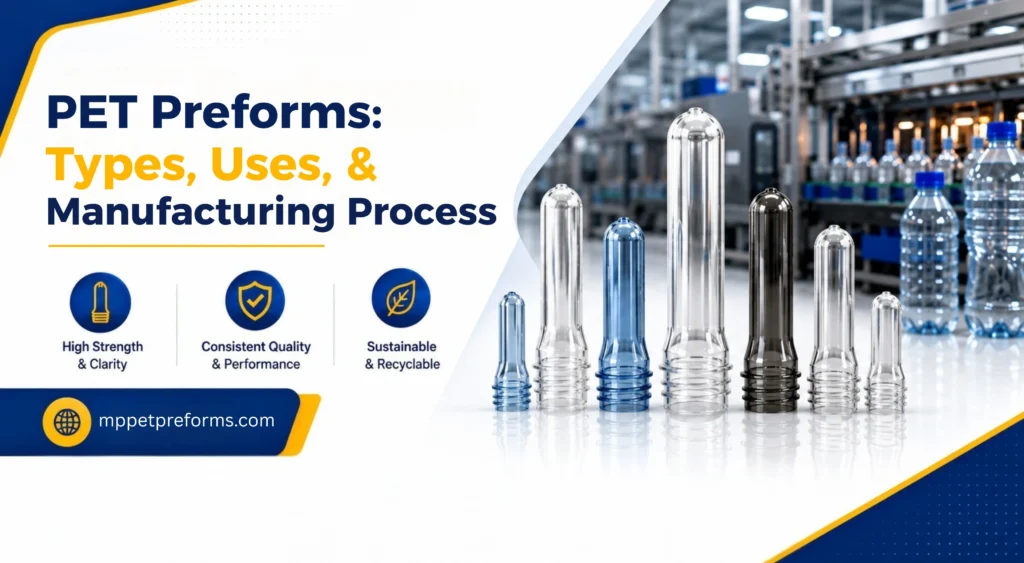
Also Read: PET Preforms: Types, Applications & Manufacturing Process
Why Is It Called a Preform?
The word preform means that the part has already been partly formed before it gets its final shape.
The neck of the bottle, including the area where the cap will fit, is already made during the preform stage. The main body is changed later during blow molding. Husky notes that PET preforms are made with precise neck finishes and controlled plastic distribution before they move to the bottle-forming stage.
This makes the preform an important link between PET raw material and the final package.
What Is PET Made From?
PET is a type of polyester plastic. According to PETRA, the main building blocks used to make PET are ethylene glycol and terephthalic acid. These materials are used to form PET resin, which is commonly supplied as small pellets. The pellets can then be heated and molded into different shapes.
Indorama Ventures also lists PET as an important raw material for bottles, sheets, films, fibres, and other products.
How Is a PET Preform Made?
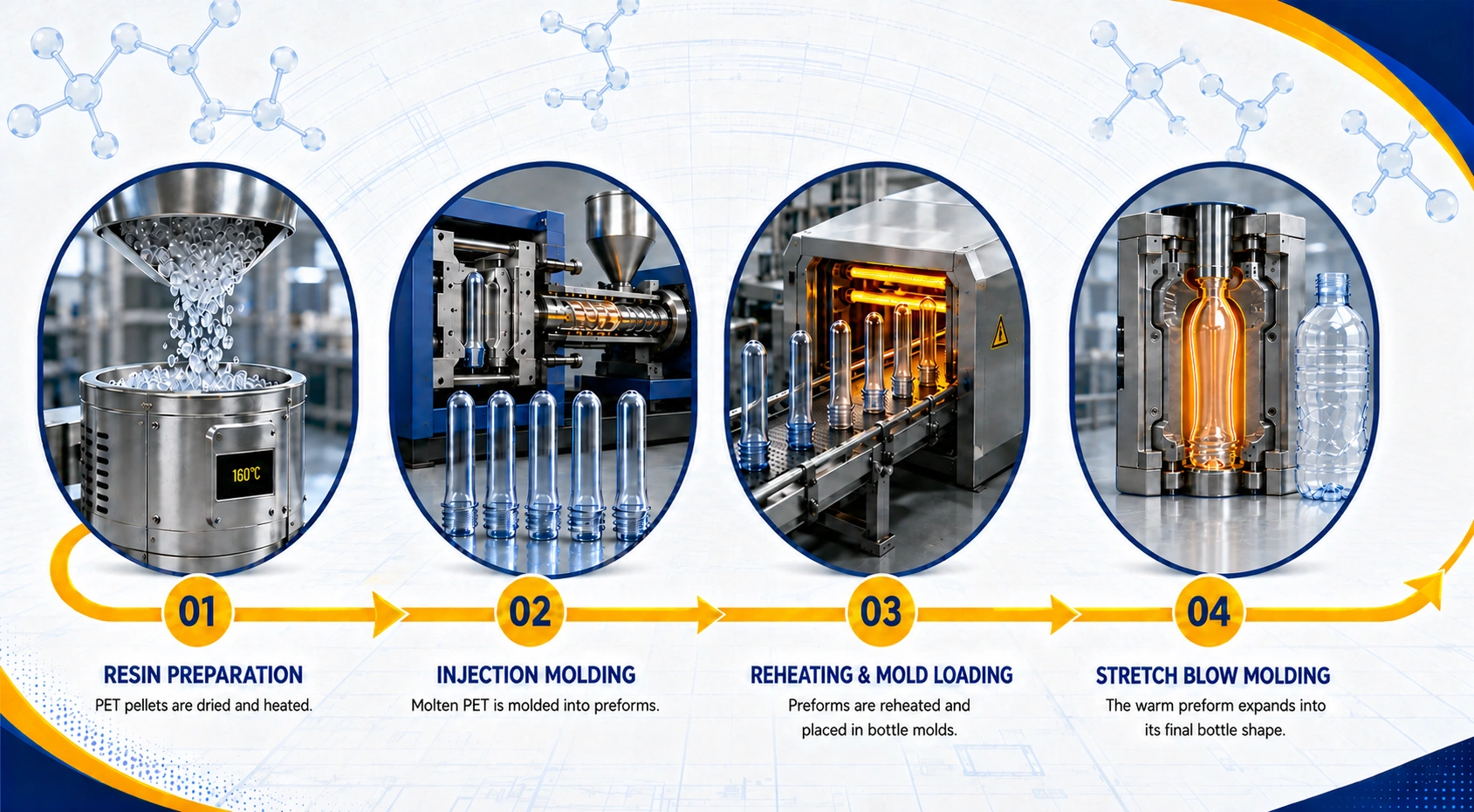
The PET preform manufacturing process can be understood in a few simple steps.
Step 1: PET Resin Is Prepared
PET normally reaches the manufacturing process as resin pellets. PETRA explains that PET pellets can be heated until the material becomes suitable for molding.
Step 2: The PET Is Injection Molded
The prepared PET is formed inside a preform mold using an injection molding system.
This process creates the preform with its required weight, neck finish, and material layout. Husky says PET injection molding systems make the preforms that form the starting point of bottle production.
Step 3: The Preform Moves to Blow Molding
The preform is not yet a full bottle. At this stage, the PET preform is still only a small, test-tube-shaped piece rather than a finished bottle. It is reheated to the right temperature and carefully placed inside a bottle-shaped mold, where it is prepared for stretching and expansion during the blow molding process.
In the next stage, it is reheated and placed inside a bottle mold.
Step 4: It Is Stretched and Blown Into Shape
The warm preform is stretched and expanded until it takes the shape of the bottle mold.
Husky describes this as the next stage after injection molding, while Sidel provides PET blowing systems that turn preforms into finished containers for different packaging needs. The result is the bottle shape that customers finally see.
Why Are PET Preforms Important?
A PET preform is important because much of the final bottle starts with the preform design.
1. It Controls How Much Material Goes Into the Bottle
The preform contains the PET that will later be spread across the finished bottle.
Husky says preforms contain the material required for the final bottle and that controlled material distribution is an important part of preform production.
Using the right preform therefore helps manufacturers control bottle weight and material use.
2. It Creates the Bottle Neck and Cap Area
The neck finish is created during the preform stage.
This area must match the required cap or closure system. Husky lists neck-finish compatibility as an important part of PET preform production.
A suitable neck design helps the bottle work with the planned closure.
3. It Affects Final Bottle Quality
The quality of the preform can affect the next production stage.
Husky states that the injection molding stage creates the foundation for part quality and material efficiency. Sidel also treats quality control from preform to bottle as an important part of PET bottle production.
In practice, this means a well-made preform gives the blowing process a better starting point.
4. It Allows Different Bottle Designs
The same general PET manufacturing method can be used for many bottle sizes and shapes.
Blow molding systems are made for different products and container formats, including water, carbonated drinks, juice, dairy products, and home or personal-care packaging.
The correct preform must still be designed for the planned bottle.
Where Are PET Preforms Used?
PET bottle preforms are mainly used to make PET bottles and containers. Depending on the PET grade, bottle design, and product needs, PET packaging is commonly used for:
- Drinking water
- Carbonated soft drinks
- Juices
- Cooking oil
- Food products
- Shampoo
- Liquid hand soap
- Mouthwash
- Personal-care products
- Some household products
PETRA lists water, soft drinks, juices, cooking oil, personal-care products, and many other goods among common PET packaging uses.
Sidel and Krones also provide PET bottle-production systems for water, carbonated drinks, juice, dairy, and home and personal-care products.
What Are the Main Benefits of PET Preforms?
The benefits of the preform are closely linked to the properties of PET itself.
Lightweight
PET is much lighter than many traditional packaging materials. PETRA describes PET as both strong and lightweight, which is one reason it is widely used for packaging.
Strong
Although PET bottles can have thin walls, the material can provide good strength when correctly designed and processed. PETRA lists strength as one of PET’s main packaging properties.
Clear Appearance
PET can provide a clear bottle that allows customers to see the product inside. PETRA describes PET as a clear plastic commonly used in packaging.
Does Not Break Like Glass
PETRA describes PET packaging as shatter-resistant, which is one reason it is widely used instead of glass for many beverage products.
Can Be Recycled
PET can be collected and processed into recycled PET, commonly called rPET. NAPCOR says recycled PET can be used as manufacturing material for new bottles and many other products. Modern PET preform systems can also process recycled PET, depending on the system and application. Actual recycling depends on the local collection and recycling system.
Are PET Preforms Safe for Food and Beverage Bottles?
PET is widely used in food and beverage packaging, but food-contact packaging must meet the rules that apply in the country where it is sold.
In the United States, federal food-contact rules allow specified polyethylene terephthalate-based materials for food-contact use under stated conditions.
For recycled PET used in food packaging, the U.S. FDA also provides guidance on recycling processes and checks whether recycled material is suitable for food-contact applications.
This is an important point for manufacturers: using PET alone does not remove the need to follow food-contact, quality, and production rules for the final application.
Virgin PET vs Recycled PET Preforms
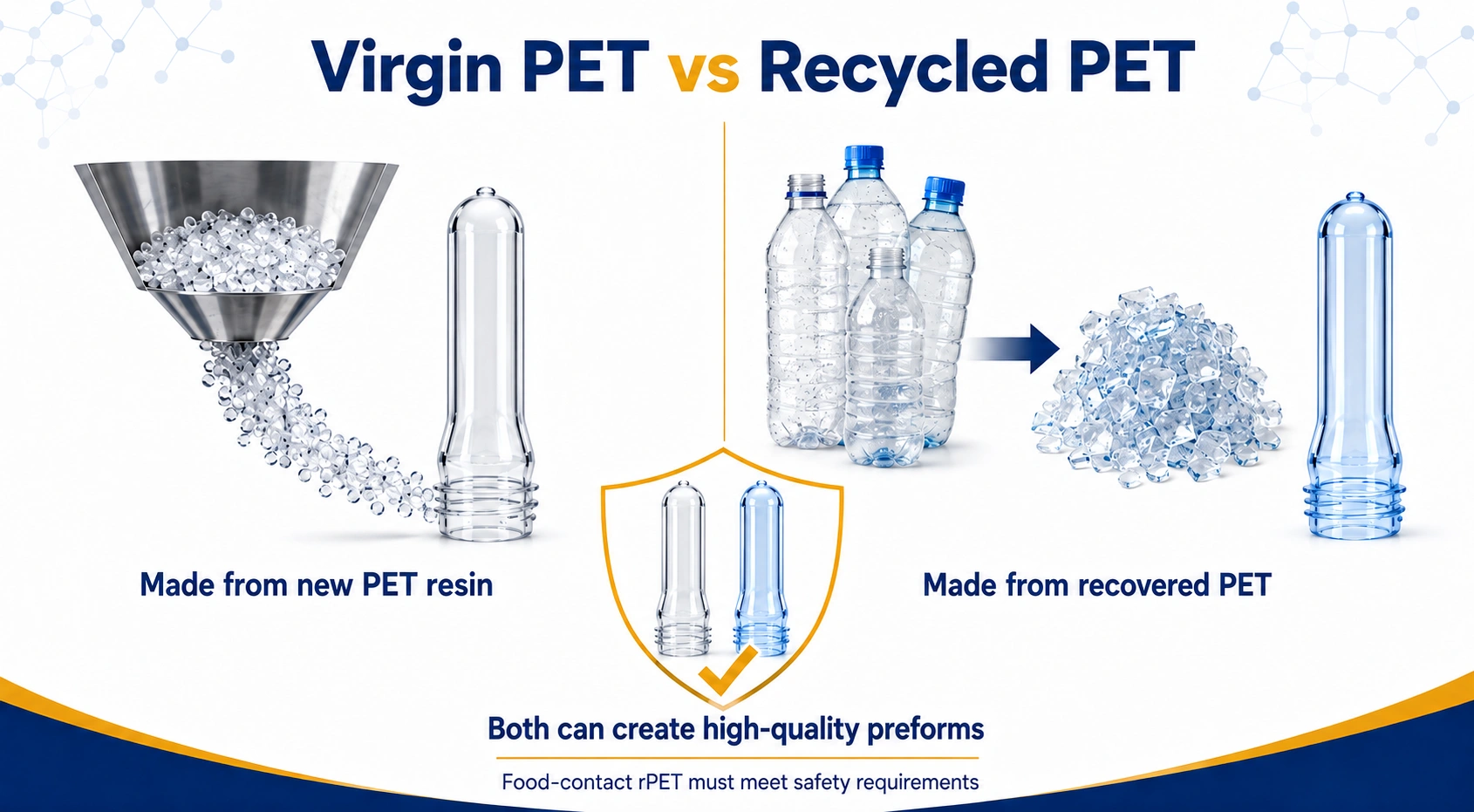
A PET preform can be made using virgin PET, recycled PET, or a suitable combination depending on the application and production system.
- Virgin PET is resin made from new raw material.
- rPET is PET that has been recovered and processed for reuse.
Modern production equipment can handle high levels of recycled PET. For example, Husky states that some of its current PET preform systems are designed to process up to 100% rPET.
For food-contact packaging, recycled material must still meet applicable safety requirements. The FDA specifically reviews food-contact issues such as possible contamination when recycled plastics are used for new food packaging.
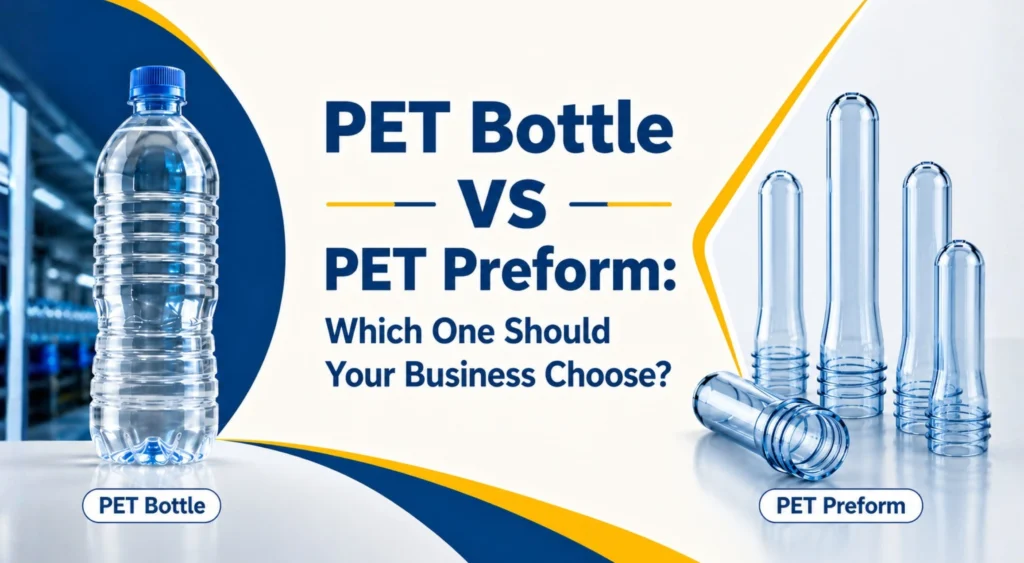
PET Preform vs PET Bottle: What Is the Difference?
The difference is simple.
- PET Preform: A partly finished molded piece that has not yet been expanded into the final container.
- PET Bottle: The final container created after reheating, stretching, and blowing the preform inside a bottle mold.
Husky describes PET injection molding and PET blow molding as two separate but connected stages: first the preform is produced, then it is reheated and stretched into the final bottle.
What Should Manufacturers Check in a PET Preform?
A preform should be selected according to the bottle and product it will be used for. Important points include:
- Preform weight
- Neck finish
- Bottle size
- Material distribution
- PET or rPET requirement
- Final product type
- Compatibility with blowing equipment
- Required production volume
Husky identifies factors such as capacity, neck-finish compatibility, recycled PET capability, cycle requirements, and material control as key points in PET preform production systems.
Manufacturers should test and approve the preform for the exact bottle and filling process rather than choosing only by price.
Also Read: How to Identify High-Quality PET Preforms Before Bulk Purchase