Purchasing PET preforms in large quantities does not mean simply comparing the gram weight and price. Even the slightest inaccuracy in terms of the resin type, neck finish, dimensions, and processibility of a pet bottle preform can be magnified when you are dealing with several thousand preforms. Choosing the correct bulk order will provide you with consistent preforms that fit your bottle shape, closure system, blowing technique, and required production capacity.
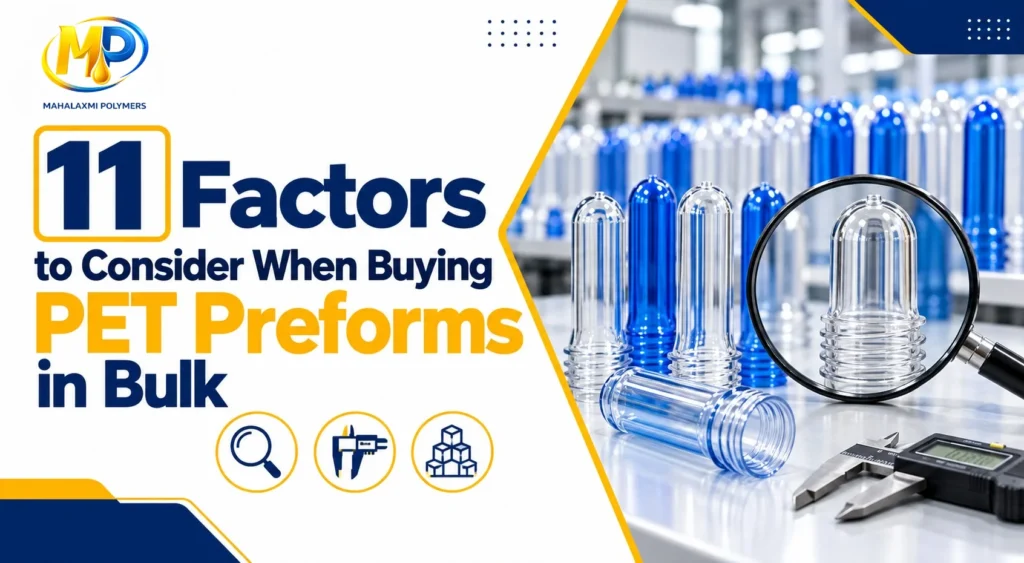
Before finalising a supplier or placing a large order, evaluate the end-use application, PET resin grade, IV value, neck finish, preform weight, dimensional consistency, machine compatibility, compliance requirements, manufacturing consistency, packaging, and total landed cost.
This list helps you determine if a PET preform is not only technically feasible, but also feasible for future manufacturing.
1. End-Use Application
Start with the product and bottle you intend to manufacture because the end-use application determines many of the preform specifications that follow. The PET preforms for bottled water, soft drinks, edible oil, juices, alcohol, food products, or pharmaceutical bottles have different specifications.
When ordering the PET preforms, consider the capacity of the final bottle, the contents of the bottle, the cap for that bottle, and strength required for the bottle, and the filling conditions. The specification of the preform should not be based on the fact that the bottles have similar contents. For instance, water bottle and liquor bottle have different preforms.
2. PET Resin Grade and IV Value
Check that the PET resin grade and intrinsic viscosity, or IV, are suitable for your intended bottle and processing requirements.
IV is an important material property because it relates to the characteristics of the PET polymer and its behaviour during processing. Different packaging applications may require different resin specifications. For bulk procurement, ask for the relevant material specification instead of assuming that every PET preform uses an identical resin grade.
If the preforms will be used for food or beverage packaging, also confirm that the material is suitable for the intended food-contact application. In India, food packaging must meet applicable FSSAI packaging requirements.
3. Neck Finish and Closure Compatibility
The PET preform neck finish must match the cap or closure that will be used on the finished bottle. Check the neck diameter, thread profile, sealing area, and closure requirement before confirming the order.
Different types of pet preforms are available for specific packaging requirements, including PCO, Alaska, CTC, liquor neck, and other application-specific neck formats. For example, MP PET Preforms manufactures multiple neck formats for water, beverages, liquor, food, and other packaging applications.
A mismatch between the preform neck and closure can result in poor sealing, leakage, cap-fitting problems, or production rejection. If you are unsure about the neck finish, share your existing bottle, closure, or capping-machine specification with the manufacturer before ordering.
4. Preform Weight and Wall Thickness
Choose the PET preform gram weight according to the finished bottle size, design, and required strength. Understanding pet preform sizes can help you select the appropriate preform dimensions and weight rather than assuming that a heavier preform is always better.
During stretch blow moulding, the material in the preform is distributed across the finished bottle. Too little material for the bottle design may affect its performance, while using unnecessary material increases resin consumption and packaging cost.
The correct gram weight therefore depends on factors such as:
- Bottle capacity
- Bottle shape
- Required wall thickness
- Product being packed
- Handling and transportation requirements
Consistency is equally important. In a bulk PET preform order, the supplier should be able to maintain the required weight within appropriate production tolerances from batch to batch.
5. Dimensional Consistency
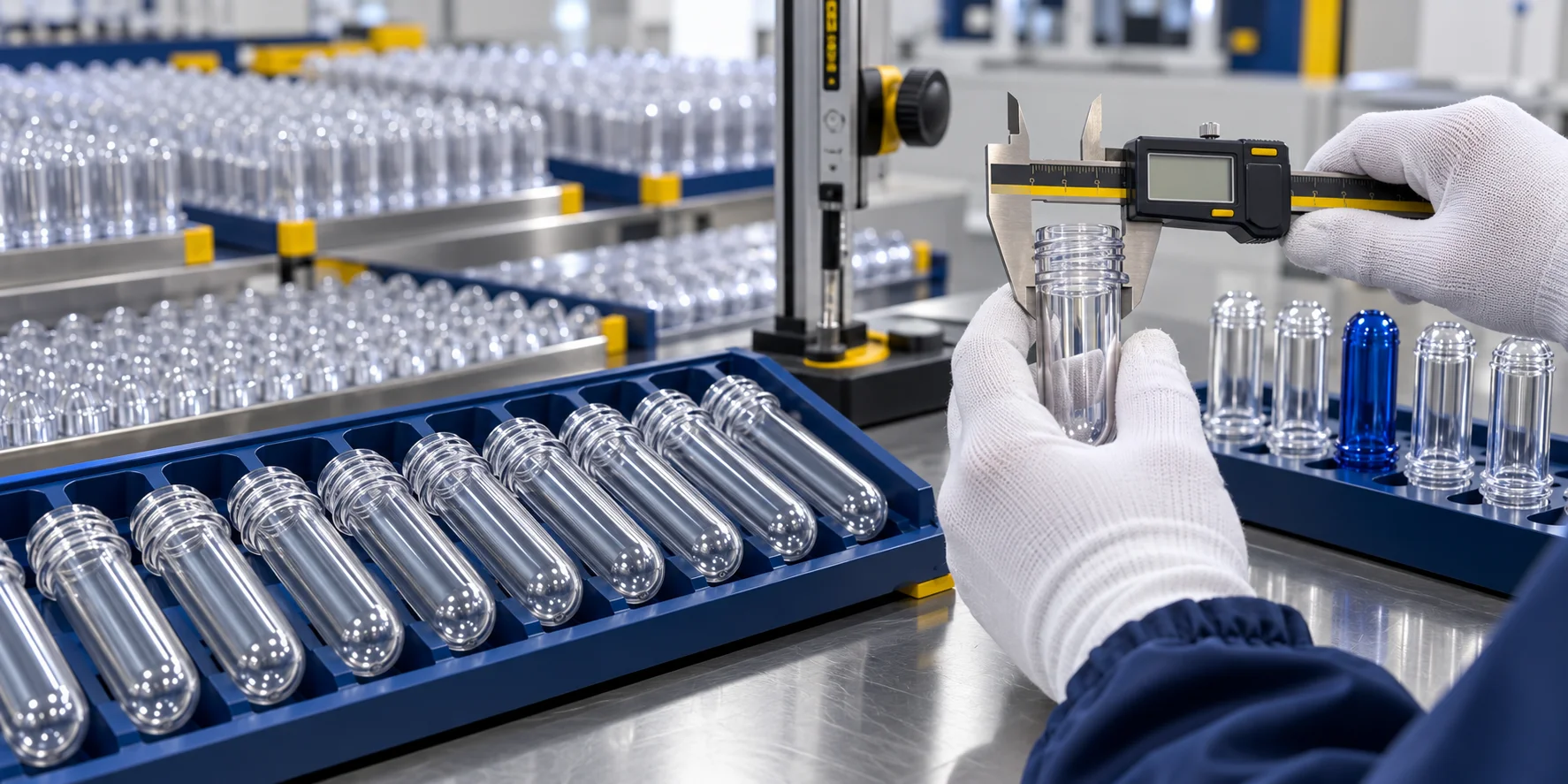
Bulk PET preforms should maintain consistent dimensions across the entire production batch. Important dimensions can include preform height, diameter, neck dimensions, wall profile, and other measurements required by your bottle and blowing setup.
Why does this matter? In high-volume production, small variations can affect how preforms move through equipment, how they heat, how they blow into the mould, and how the finished bottle fits its closure.
A single good sample is therefore not enough to judge a bulk supplier. What matters is whether the same specification can be maintained across thousands or lakhs of preforms.
6. Blow-Moulding Machine Compatibility
Make sure the PET preform is compatible with your blow-moulding machine and bottle mould before placing a large order. Two preforms with a similar gram weight may not necessarily behave identically during production. Their dimensions, neck finish, geometry, and material distribution can affect heating and blowing performance.
Where possible, test samples on your actual production line. A production trial can help you identify issues such as poor bottle formation, uneven material distribution, unsuitable handling, or incompatibility before they affect a full commercial batch.
7. Food-Contact and Regulatory Compliance
For food and beverage packaging, verify that the PET preforms meet the regulatory and material requirements applicable to the intended use. Do not rely only on the phrase “food grade.” Ask for relevant specifications or supporting documentation where required.
In India, FSSAI regulates materials used for food packaging, including specific requirements relating to PET and food-contact recycled PET.
MP PET Preforms states that its food-contact preforms are manufactured from virgin, food-grade PET resin and that recycled or blended material is not used in its food-contact products.
For non-food applications, check any product-specific packaging or regulatory requirements that may apply to your industry.
8. Colour, Clarity, and Special Requirements
Choose PET preform colour and appearance according to the finished bottle and product requirement.
Clear preforms are suitable when product visibility is important, while coloured or tinted preforms may be selected for branding or application-specific needs.
When ordering in bulk, specify the exact colour requirement rather than accepting a general description such as “blue” or “green.” Colour consistency can become important when finished bottles from different production batches appear together in the market.
If your application requires a particular masterbatch, tint, or other special material characteristic, include it in the agreed preform specification before production.
9. Supplier Manufacturing Consistency
For bulk orders, choose a PET preform manufacturer that can maintain the required specification consistently across repeat production batches.
This is different from simply checking whether a supplier can manufacture one acceptable sample. Knowing how to identify high-quality pet preforms can help you evaluate material consistency, dimensions, moulding quality, and overall production reliability before placing repeat bulk orders.
Ask how the manufacturer controls:
- Raw material
- Gram weight
- Neck dimensions
- Moulding parameters
- Visual defects
- Batch quality
- Packing and dispatch
Consistent manufacturing can reduce the need to repeatedly adjust your production process when a new batch arrives.
10. Packaging and Transportation
Consider how PET preforms will be packed, stored, and transported to your production facility.
Bulk preforms need packaging that protects them from contamination, unnecessary handling damage, and deformation during storage or movement.
Also consider how packaging affects freight efficiency. Heavier preforms, different pack quantities, and longer transport distances can all influence logistics costs.
Before ordering, confirm the pack quantity, shipment method, delivery location, and handling requirements so that the delivered quantity and freight cost can be calculated accurately.
11. Total Landed Cost
Compare the total cost of receiving usable PET preforms at your factory, not just the supplier’s price per piece.
The actual bulk-purchase cost can include:
preform price + packaging + freight + handling + rejection losses + production impact.
A lower-priced preform may not be economical if dimensional inconsistency or poor compatibility leads to higher rejection rates or production interruptions.
Similarly, freight can materially affect the final cost when large quantities are being transported across states.
For bulk procurement, the better comparison is therefore cost per usable preform delivered to your facility, rather than the quoted unit price alone.
What Quality Checks Should You Perform Before Ordering PET Preforms in Bulk?
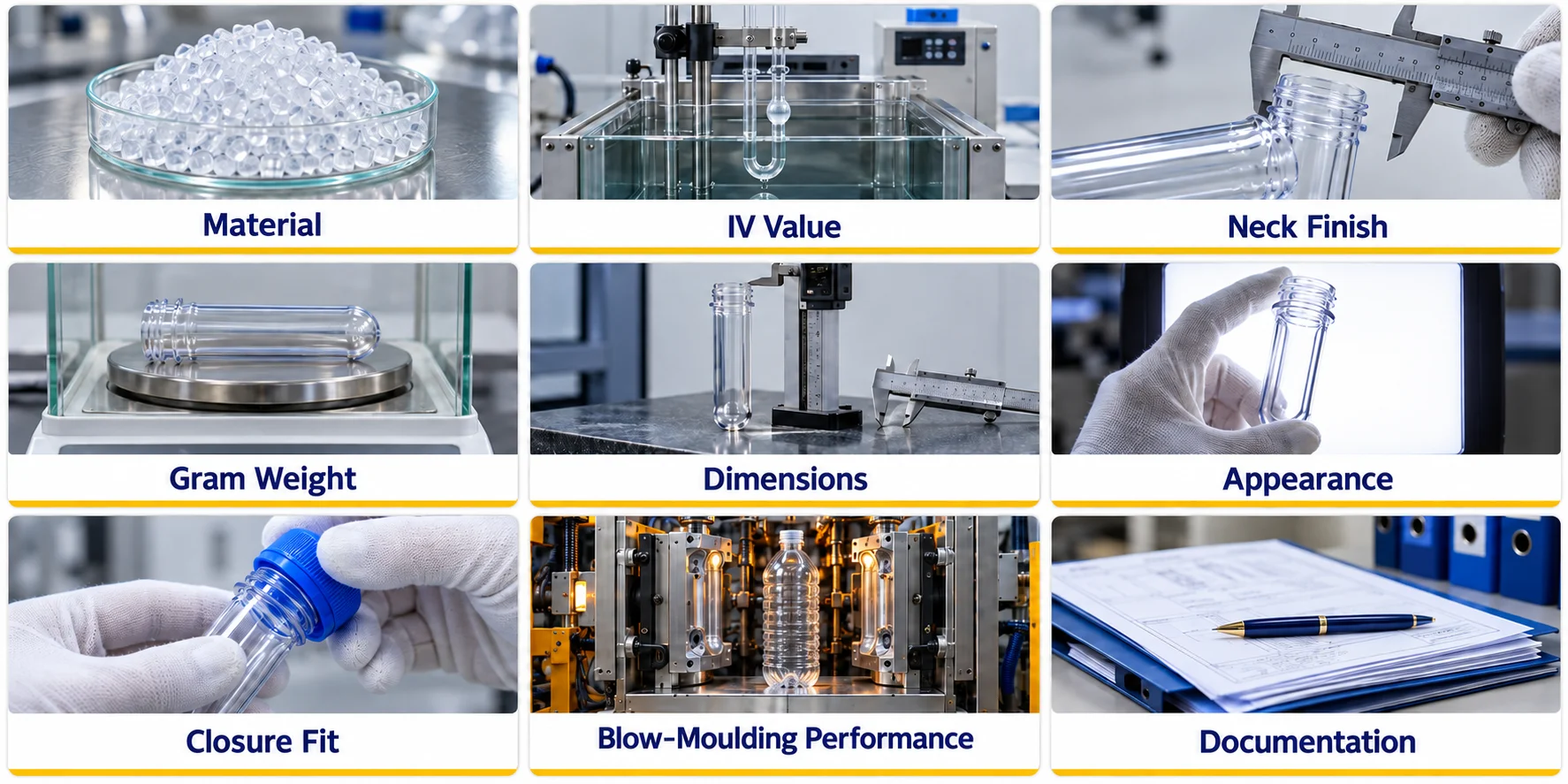
Before approving a bulk PET preform order, verify that the sample and technical specification match your production requirements.
Check:
- Material: Confirm the required PET resin specification.
- IV value: Verify it where relevant to your application.
- Neck finish: Check dimensions and closure compatibility.
- Gram weight: Confirm the required weight and tolerance.
- Dimensions: Measure important height, diameter, and neck specifications.
- Appearance: Inspect clarity, colour, flash, gate quality, contamination, and visible moulding defects.
- Closure fit: Test the intended cap or closure.
- Blow-moulding performance: Run a machine trial where appropriate.
- Documentation: Verify relevant food-contact or application-specific documents.
For repeat bulk orders, an approved sample or agreed written specification can provide a useful reference for checking future batches.